
GTX-DS-3DCP-Construction Corp. is exploring the application of large-scale robotic concrete printing across residential, commercial, public, and specialized construction sectors.
By combining digital design, construction experience, and emerging automated building systems, we aim to evaluate new approaches to concrete construction, architectural flexibility, and project efficiency.
3D Concrete Printing for the Future of Construction
A Home. A New Way to Build.
The first planned residential initiative by GTX-DS-3DCP-Construction Corp. on Long Island, New York, will explore the potential of robotic 3D concrete printing in residential construction.
Currently in the planning and technology evaluation stage, the project will serve as a developing case study, documenting technical decisions, project milestones, and progress toward construction.
WHAT CAN WE BUILD?
From homes to large-scale infrastructure.
These sectors represent potential applications of large-scale 3D concrete printing. Each project's feasibility depends on engineering requirements, site conditions, available equipment, building codes, and necessary approvals.
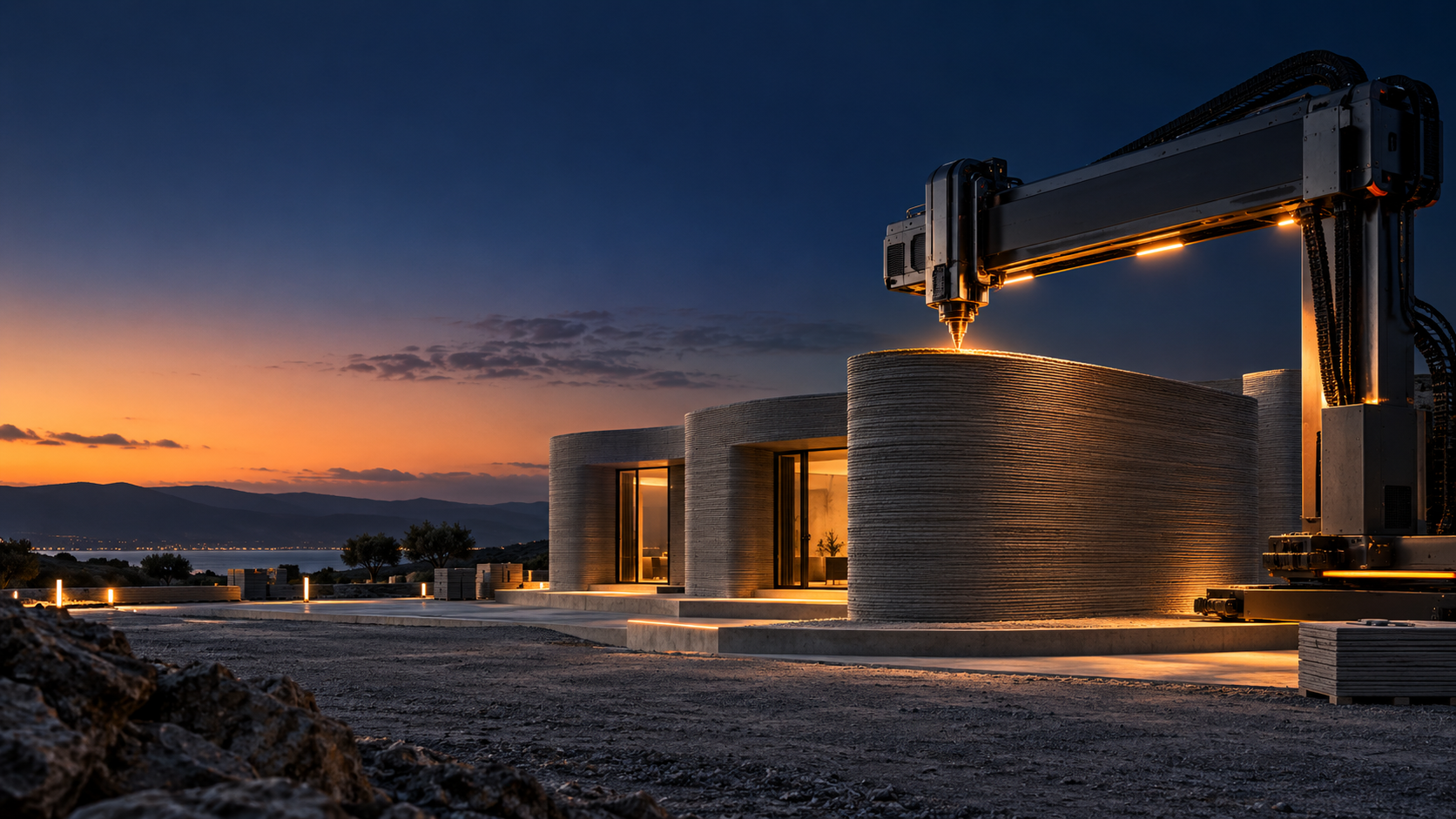
Conceptual visualization illustrating future applications of automated construction technology.
RESIDENTIAL
3D Printed Homes &
Residential Construction
Large-scale 3D concrete printing introduces a new approach to residential construction by transforming digital architectural designs into physical concrete structures.
The technology can be used for single-family homes, multi-unit developments and customized residential structures while allowing architects and developers greater freedom in shape, layout and design.
Applications include:
Single-family homes
Multi-family housing
Affordable housing developments
Accessory structures
Custom homes
Residential communities
Architectural concrete features
COMMERCIAL
3D Concrete Printing for Commercial Construction
3D concrete printing can support commercial developments where speed, repeatability, design flexibility and efficient material use are important.
Digital construction allows building concepts to move directly from a 3D model to an automated printing system, creating walls and structural forms with a high level of repeatability.
Applications include:
Offices
Retail buildings
Restaurants
Hospitality structures
Warehouses
Industrial facilities
Commercial developments
Architectural installations
PUBLIC
Public Infrastructure &
Community Projects
Large-scale additive construction can also be applied to public and community infrastructure.
3D concrete printing provides engineers, municipalities and developers with another method for creating durable concrete structures while reducing traditional formwork and enabling complex geometries directly from digital designs.
Applications include:
Municipal buildings
Community facilities
Schools and educational structures
Public housing
Utility structures
Transportation infrastructure
Parks and recreational structures
Walls and barriers
DEFENSE & SPECIALIZED INFRASTRUCTURE
Rapid Construction for Specialized Environments
Large-scale 3D concrete printing has potential applications in defense, remote construction and specialized infrastructure where traditional construction may be difficult, expensive or time-intensive.
Automated construction systems can provide a flexible method for producing structures from digital designs while reducing dependence on conventional formwork and complex construction logistics.
Potential applications include:
Operations and support structures
Equipment shelters
Protective structures
Storage facilities
Training facilities
Remote-site construction
Perimeter structures
Temporary structures and infrastructure components
BEYOND TRADITIONAL CONSTRUCTION
If it can be designed digitally,
3D concrete printing may open a new way to build it.
One of the most significant advantages of additive construction is design flexibility. Structures that would normally require complicated molds or formwork can potentially be created directly from a digital model.
Applications can extend beyond conventional buildings into architecture, infrastructure, landscaping and custom concrete manufacturing.
Additional applications include:
Architectural walls
Curved concrete structures
Street furniture
Landscape features
Outdoor structures
Retaining walls
Decorative concrete elements
Custom-designed components
Research and prototype structures
FROM DIGITAL DESIGN TO PHYSICAL STRUCTURE
A new construction workflow.
Every project begins digitally.
A structure can be designed using architectural and engineering software, translated into machine-readable construction data and prepared for large-scale concrete printing.
The printing system then follows the programmed tool-path, depositing material layer by layer to create the designed structure.
DESIGN → ENGINEERING → DIGITAL MODEL → PRINTING → CONSTRUCTION
HAVE A PROJECT IN MIND?
Let’s explore what 3D concrete printing can make possible.
Every construction project presents unique opportunities and challenges. GTX-DS-3DCP-Construction Corp. welcomes discussions with developers, architects, engineers, and property owners interested in exploring the potential of large-scale 3D concrete printing.